


Međunarodna politika Journal Archive
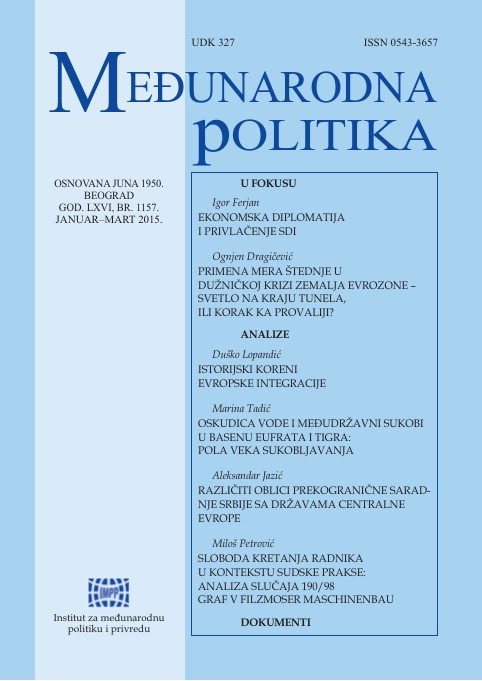
Međunarodna politika Vol. 66 No. 1157/2015
Content
Međunarodna politika, 2015 66(1157):5-18
 80.55 KB)
Abstract ▼
Attraction of investments from abroad, today represent interest of every country, both developed as well as developing countries. Considering today’s economic crisis, each country in particular is trying to attract investments and it sets investment attraction as the modality for overcoming the crisis. To succeeded, countries in various ways engage individuals and groups from government and NGO sector, but a key role in attracting foreign direct investments is left to diplomacy, especially to economic diplomacy. Therefore, the primary goal of this article is the affirmation of economic diplomacy and its role on attraction of foreign direct investment, but to meet this goal, the article present the concept of economic diplomacy and investment, as well as place in relation the promotion of economic diplomacy and attraction of foreign direct investments. During scientific reasoning, proving set hypothesis, and researching the role of economic diplomacy on attraction of foreign direct investments, special attention is committed to the relation of economic diplomacy and promotion and attraction of foreign direct investment. At the end of the article author adduce measures how to pave the way for attracting foreign investments with quality economic diplomats.
Međunarodna politika, 2015 66(1157):19-36
Abstract ▼
In this article, the author indicates the reasons why the austerity measures have failed to resolve the problems of public debt increase and recessions in the Eurozone periphery countries. The main cause for inefficiency of these measures should seek in incorrect diagnosis of the root of the current financial crisis in Euro area. More precisely, above mentioned cause should search in incomprehension of the austerity policy creators that the crisis is a product of cumulative consequences of constraints and weaknesses of the European Monetary Union (EMU), rather than irresponsible and wasteful behavior of the public sector of some EMU member states.
Međunarodna politika, 2015 66(1157):37-47
Abstract ▼
In contemporary international relations, energy security became a topic that occupies a priority place at the global level as well as internal policies and security strategies of individual states. Energy security of the state realizes the action of the internal and external levels. Very few countries can meet their energy needs from its own resources. Therefore, most countries have to cooperate with each other to provide the required amount of energy. The pipeline “South Stream” has emerged as the need of Europe to southern and central parts of its natural gas supply from Russia. For Serbia, through which it had to pass, it was of great importance in terms of energy security.
Međunarodna politika, 2015 66(1157):48-59
Abstract ▼
The paper points out the basic elements of EU policy on climate change through the presentation of policy objectives in this area as defined in the strategic documents of the organization. Certain provisions of the “Europe 2020” Strategy are particularly analyzed. It is given an overview of the results achieved so far in achieving the objectives defined in the strategy “Europe 2020”. The last part of the paper emphasizes the importance of EU policy in the field of climate change for the Republic of Serbia, as a country which is a candidate for EU membership. The similarities and differences in the current position of the Republic of Serbia and the European Union in this area are pointed out. The existence of the several circumstances that contribute to differences in the position of the Republic of Serbia in relation to the objectives of the EU is noted.
Analize
Međunarodna politika, 2015 66(1157):60-72
Abstract ▼
Previous attempts of European uniting were violnet. Rome, Frankish empire, Napoleon\'s empire were product of warrior spirit, based on the will of the warring fighter. European Community was different. It was creation of politicians, traders, bankers and lawyers, based on the ideas of free market, documents, commercial contracts, letters of credit, business freedom, and guarantees of business word. The idea of European unification intensively developed at the beginning of the twentieth century through Briand’s project of the European Union federal; Spinelli’s Manifesto for a free and united Europe; the Federal Union of European nations; Churchill\'s idea of United States of Europe. A concrete result of the formation of European Economic Community (later European Union) occurs after the second world war as the result of four factors: dramatic wartime destruction of European countries, efforts of France and Germany to find a post-war modus vivendi, prewar ideological movements for European integration, and the beginning of American Cold War policy.
Međunarodna politika, 2015 66(1157):73-85
Abstract ▼
The article explores the influence of water scarcity on the emergence and dynamics of interstate conflicts on the case study of the EuphratesTigris basin. Giving the fact that rapidly consumed water supplies can be physically controllable, water scarcity represents one of the causes that may contribute significantly to the development of interstate conflicts. International river basins are in special risk of these conflicts, particularly if other causes of interstate confrontation and intrastate divides exist. Water consumption has been among principal causes of conflict between Turkey, Syria, and Iraq for half a century. As all three states address this issue from narrow national perspectives, reaching a tripartite agreement on water sharing remains uncertain. This problem becomes even more important due to the increasing water scarcity and unstable relations in the region.
Međunarodna politika, 2015 66(1157):86-97
Abstract ▼
In the focus of the author’s research are some forms of cooperation between Serbia and the countries from Central Europe. This cooperation is unilateral and multilateral. Regions are connecting in different way with the purpose of political, economic and social development. Most often form of multilateral regional cooperation are euroregions. On the other side, states cooperate through regional initiatives. Višegrad Group is one of the best examples of cooperation between states within regional initiative. Member states of this regional initiative fulfilled their main goal which was joining the European Union. But, this regional initivative still exist because of advantanges that member states have from it. Key representative of Serbia in regional cooperation is Autonomous Province of Vojvodina. This north province of Serbia has well developed unilateral and multilateral cooperation with regions from Central Europe. Also, Vojvodina is member of few European organizations that gathers regional authorities. That way, through cooperation of its regional authorities Serbia is becoming closer partner to European Union member states.
Međunarodna politika, 2015 66(1157):98-111
Abstract ▼
Provisions of Austrian law which entitled a right to a compensation in cases of termination of work relation collided with the principle of free movement of workers, from the standpoint of former Article 39 EC. Could this article „rule out“ the domestic legislation which did not envisage a compensation in the case of termination of employment, by those workers who completed their working contract and departed for taking another job in the same or other EU member-state? Core issue regards the extent of prohibition of non-discriminatory limitations to freedom of movement of workers according to article 45 TFEU, in line with the Bosman ruling. In Graf judgment, Court of Justice analyzes the limits to case-law, relying to a significant degree on the enforcement of so-called Keck doctrine in the area of free movement of workers. Opinion of Advocate-General has initiated other questions, such as the market-access aspect, and the general test (Bosman). Concepts of „obstacle“ and „discrimination“ are identified as insufficiently precise, and qualification „too uncertain and indirect“ has not contributed to their closer specification, nor to development of relevant case-law of the Court of Justice.
Prikaz
REGIONALISM AND RECONCILIATION
Međunarodna politika, 2015 66(1157):112-113
„SPOLJNOPOLITIČKI DIJALOZI: DRŽAVE ZAPADNOG BALKANA NA PUTU KA EVROPSKIM INTEGRACIJAMA”
Međunarodna politika, 2015 66(1157):114-116
Dokumenti
PREDSEDNIK NIKOLIĆ O PRESUDI MEĐUNARODNOG SUDA PRAVDE U SPORU SRBIJE I HRVATSKE
Međunarodna politika, 2015 66(1157):119-119
UČEŠĆE PREDSEDAVAJUĆEG OEBS IVICE DAČIĆA NA ZIMSKOM ZASEDANJU PARLAMENTARNE SKUPŠTINE OEBS U BEČU
Međunarodna politika, 2015 66(1157):120-122