


Međunarodna politika Journal Archive
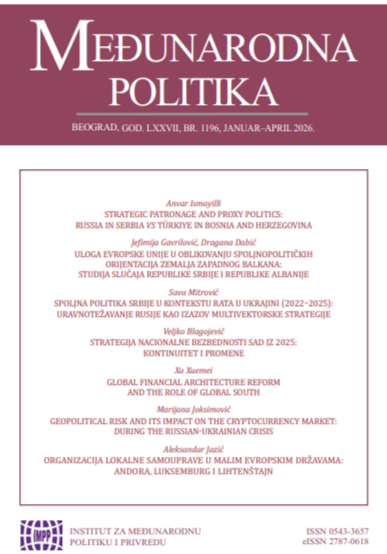
Međunarodna politika Vol. 77 No. 1196/2026
Content
Međunarodna politika, 2026 77(1196):7-28
 185.52 KB)
Abstract ▼
This paper investigates the asymmetric geopolitical strategies of Russia and Türkiye in the Western Balkans through a comparative case study of their respective alignments with Serbia and Bosnia and Herzegovina. As Euro-Atlantic institutions face objective challenges in deepening integration across the region, Russia and Türkiye have expanded their influence by cultivating strategic partnerships grounded in historical, cultural, and identity-based ties. This dynamic has resulted in a de facto proxy structure: Serbia emerging as Russia’s principal strategic partner in the post-Yugoslav space, and the Bosnian political establishment functioning as Türkiye’s core associate within the complex landscape of Bosnia and Herzegovina, in which competing external aspirations and the Croatian political element play a considerable role in shaping the domestic landscape. Using a constructivist and neo-imperial theoretical lens, the paper argues that although Russia and Türkiye pursue distinct modalities of influence, both strategically engage with and reinforce historically embedded identity cleavages. In doing so, they shape a regional order, characterised by selective alignments and competing external orientations. The paper concludes by assessing the implications for regional stability, EU/NATO enlargement, and the evolving balance of power in the Western Balkans.
Jefimija Gavrilović, Dragana Dabić 
Međunarodna politika, 2026 77(1196):29-46
Abstract ▼
This paper explores the role of the European Union in shaping the foreign policy orientation of Western Balkan countries through a comparative case study of Serbia and Albania. The aim of the research is to indicate the factors leading to different outcomes of Europeanization in the region, and to demonstrate the effectiveness and limitations of the EU’s normative influence on the foreign policies of candidate countries. The theoretical framework is based on the concept of the EU’s normative power and the theory of Europeanization, which combined explain how the EU seeks to transfer its norms and values to candidate countries, and show ways in which those countries either internalize or reject those norms and values. Through comparative and qualitative methodological analysis, the paper presents the EU’s foreign policy instruments applied in its relations with Western Balkan countries, as well as the different foreign policy orientations of Serbia and Albania. The EU is a unique actor in the region, whose impact is conditioned by the specific national context of each country, historical legacies, geopolitical priorities, and political narratives, as well as by the credibility of the enlargement process and the consistent application of conditionality mechanisms. The paper concludes that the EU’s role is differentiated and conditioned both by the mechanisms it applies in the Europeanization process and by the internal characteristics of candidate countries, pointing to the need for reevaluation of the existing EU policies and strengthening the socio political will of regional states to internalize European values and norms.
Međunarodna politika, 2026 77(1196):47-77
Abstract ▼
In an international environment marked by an increasingly pronounced confrontation between the West and the East, Serbia’s foreign policy strategy has been exposed to a range of growing challenges. Following Russia’s invasion of Ukraine in 2022, Serbia’s multi-vector faced its most severe stress test to date. Far more intensively than after the annexation of Crimea, Serbia was subjected to pressure to join a coalition aimed at the comprehensive balancing of the Russian Federation. Against this backdrop, the article proposes a two-dimensional balancing strategy matrix to analyse Serbia’s diplomatic, economic, and security-related measures of balancing Russia. The central research question addressed in this study is whether Serbia, through the balancing measures it has undertaken, has abandoned its multi-vector foreign policy strategy after 2022. The findings indicate that Serbia has frequently, albeit selectively, employed mechanisms of diplomatic balancing against Russia, while simultaneously seeking to mitigate their effects by maintaining high-level contacts and publicly justifying these decisions as the product of external pressures and coercion. By reducing the scope of military-technical cooperation with Russia and indirectly supplying arms to Ukraine, Serbia has also engaged in low- to medium-intensity security balancing against Russia. However, by refusing to impose sanctions and to terminate its energy arrangements with Moscow, Serbia has refrained from economic balancing. The selectivity of Serbia’s balancing behaviour, its predominantly low to medium intensity, and persistent efforts to mitigate its impact at the bilateral level, suggest that balancing against Russia is better understood as tactical manoeuvring within the framework of a broader multi-vector strategy, rather than as a fundamental strategic reorientation.
Međunarodna politika, 2026 77(1196):79-103
Abstract ▼
This paper analyses the National Security Strategy (NSS) of the United States from 2025 as the most important strategic document of American foreign and security policy. The scientific and professional public often discusses the significant changes brought about by this document. However, the constants of American foreign and security policy are incomparably less mentioned. The goal is to examine the key trends of continuity and change in relation to the previous strategies, the 2017 National Security Strategy and the 2022 National Security Strategy. Qualitative content analysis, a systemic comparative approach, and secondary analysis of relevant literature were used. The paper indicates that the 2025 National Security Strategy embodies the traditional elements of the American strategic approach, the importance of economic and technological power, the role of alliances in deterrence, and the need to strengthen the effectiveness of national institutions. At the same time, it introduces significant changes: a dramatic reorientation towards the Western Hemisphere, a new ideological rhetoric towards European partners, a redefinition of relations with Russia and a more explicit use of force in the fight against transnational crime. The paper concludes that the 2025 National Security Strategy represents a paradigmatic hybrid of continuity and change, which will have significant consequences for global order, transatlantic relations, and regional stability, particularly in the context of a reaffirmation of the Monroe Doctrine. Essentially, the subject of the research is an effort to answer the basic question of how the current US administration intends to maintain the US’s position in the global environment, which presents challenges to its dominance and is radically and rapidly changing.
Međunarodna politika, 2026 77(1196):105-120
Abstract ▼
The existing global financial architecture is increasingly revealing structural flaws in addressing multiple systemic crises, with issues such as dollar hegemony, governance inequity, inadequate representation, and a lack of development orientation becoming particularly pronounced. By employing qualitative research methods and drawing on fundamental theories in international relations, this paper argues that the Global South has transformed from a passive rule-taker into an active reform participant in the reform of global financial architecture through rising economic power, institutional innovation, and consensus forging. However, internal heterogeneity, resistance from existing power structures, and capacity limitations constitute major constraints. The paper posits that, in future reforms, the Global South must strengthen internal coordination, enhance institutional capabilities, and build broad reform coalitions to establish a more equitable, efficient, and inclusive global financial architecture.
Međunarodna politika, 2026 77(1196):121-135
Abstract ▼
This study examines the relationship between geopolitical risk and the behaviour of the cryptocurrency market during the Russian-Ukrainian crisis. It focuses on major cryptocurrencies. Using an event-based descriptive approach, the study analyses price volatility and trading volumes of Bitcoin (BTC), Ethereum (ETH), and the stablecoin Tether (USDT), as well as investor behaviour during key geopolitical events from Q4 2021 to Q2 2023. Data were collected from public sources, harmonised across exchanges, and cleaned for missing values and anomalies to ensure reliability. Results show that major events, such as Russia’s invasion and subsequent sanctions, triggered sharp short-term fluctuations in BTC and ETH prices, as well as increased volatility and trading activity. USDT remained price-stable but saw significant surges in trading volume, highlighting its role as a temporary safe haven during market uncertainty. These patterns illustrate a dual role of cryptocurrencies during crises: volatile coins react strongly to shocks, while stablecoins provide liquidity and preserve value. The study demonstrates that cryptocurrencies are sensitive to geopolitical developments despite decentralisation. The findings underscore the need for monitoring digital asset markets during political and economic turmoil and offer insights for investors, regulators, and policymakers on the evolving role of cryptocurrencies and stablecoins in global finance. This descriptive analysis does not infer causality but provides a clear and replicable overview of market responses to geopolitical risk.
Međunarodna politika, 2026 77(1196):137-152
Abstract ▼
Today in Europe there are several countries that occupy an extremely small territory, which is why many of them are considered city-states. Nevertheless, in all these countries there is local self-government. The organization of local self-governments in those countries is not organized in the same way as in other European countries, which is expected due to their territorial size. The establishment of local self-governments in countries with an extremely small territory clearly indicates the importance of organizing lower levels of government. The subject of this paper will be the territorial division of power in Andorra, Luxembourg and Liechtenstein. The aim of the work is to analyze all existing lower levels of government in these states, as well as the way in which they function in terms of their powers. A special emphasis will be placed on the municipal level of government, that is, the one that is parallel or similar to it. The main question in the paper will be how the territorial and institutional specificity of small states shapes the relationship between the central government and local self-government. The small territorial size of the state represents a structural limitation for complete decentralization. This leads to a stronger role of central authorities in the supervision and control of local self-government.