

International Politics
International Politics is a peer-reviewed, open-access scientific journal published by the Institute of International Politics and Economics, the leading scientific institution in the region dedicated to researching international relations. For more than 70 years, this interdisciplinary journal has published original analytical, theoretical, and review papers on a wide range of contemporary international political, economic, and legal relations.More details
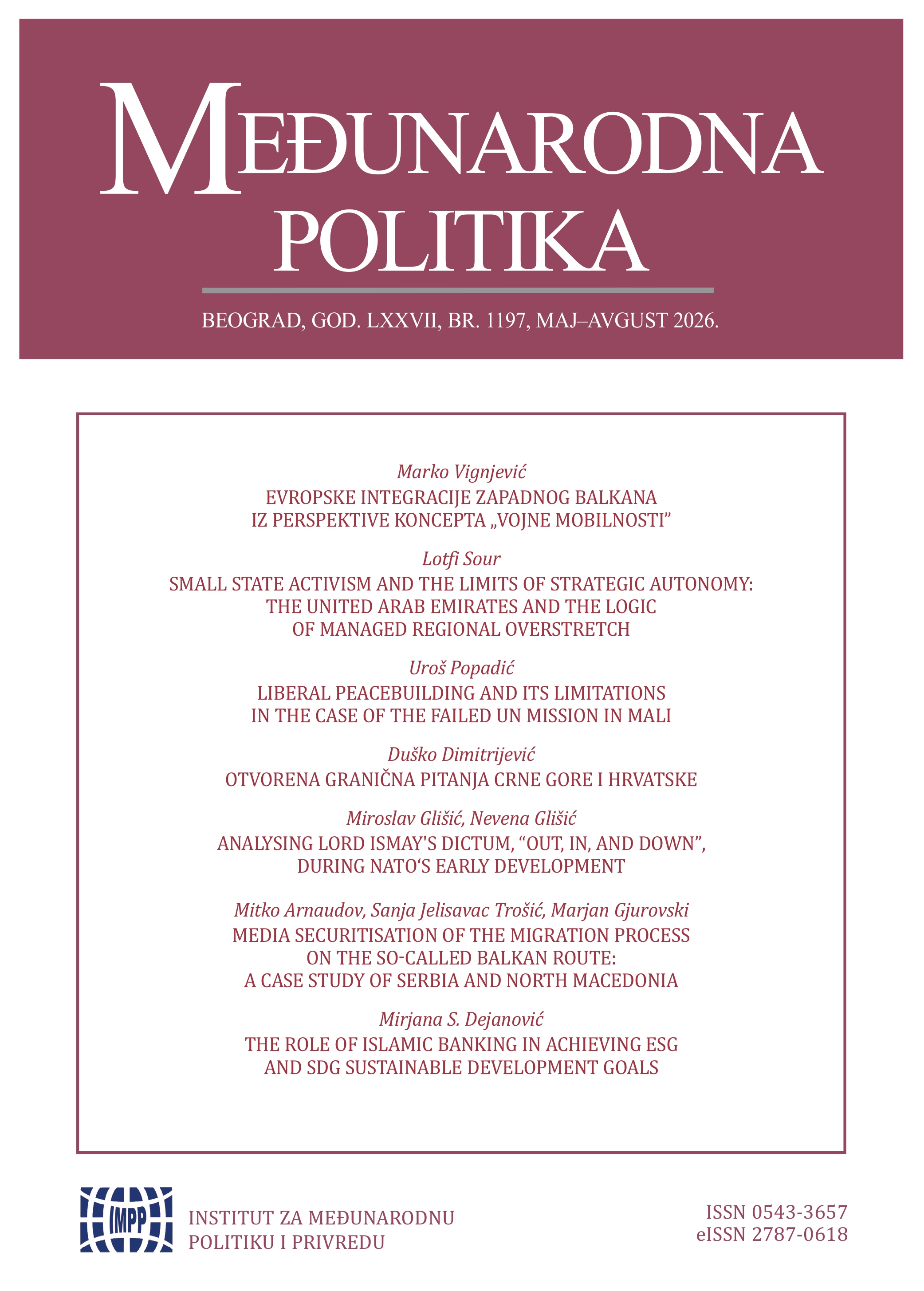
Latest issue: Međunarodna politika Vol. 77 No. 1197/2026
Content
Međunarodna politika, 2026 77(1197):197-218
 197.62 KB)
Abstract ▼
The concept of “military mobility” represents a framework in which, under the geopolitical and geostrategic influences of the war in Ukraine, the cooperation of NATO (North Atlantic Treaty Organization-NATO) and the European Union (European Union-EU) could be more intense. The paper raises the question of whether this concept can influence the process of European integration of countries that, together with the so-called Do Kosovo constitute the geopolitical construction of the Western Balkans? In this regard, the assumption is that the EU enlargement policy, which until now followed the geostrategy of the North Atlantic Alliance towards Russia, would set as a criterion the importance of the position on the corridors for military transport. The first part of the paper begins with a theoretical overview of the relations between states and their alliances due to challenges in anarchic international relations, followed by an analysis of relevant NATO and EU strategic documents. The aim of this analysis is to point out the concept of “military mobility”, its strategic perspectives and overall importance with NATO and EU cooperation. In the second part, the paper specifically deals with the position of the Western Balkans on the “military mobility” corridors that NATO and the EU have foreseen in the context of a hypothetical conflict with Russia. The position of certain Western Balkan states is shown in comparison, where the importance of that position is apostrophized from the angles of the concrete corridor and the potential strategic interconnection between two or more corridors of “military mobility”. The analysis showed that the geostrategic importance is primarily determined by the access to the Adriatic Sea. The conclusion of this paper is based on this, that in the process of European integration of the Western Balkans, and from the perspective of the concept of “military mobility”, Albania and Montenegro have the greatest advantage in becoming new EU members.
Međunarodna politika, 2026 77(1197):219-249
Abstract ▼
This article develops a neoclassical realist framework to explain how the United Arab Emirates (UAE), despite its small territorial size, limited manpower, and demographic constraints, has sustained an expansive pattern of regional activism across Yemen, Libya, and the Horn of Africa/Red Sea corridor. Situating the UAE within the post-2011 transformation of Arab regional order, the article introduces two interrelated conceptual innovations: managed strategic autonomy and managed regional overstretch. Managed strategic autonomy is distinguished from hedging, omnibalancing, and strategic diversification by its active intent to reshape the patron-client relationship rather than distribute risk or cultivate domestic legitimacy. Managed regional overstretch extends Kennedy’s classical overstretch theory beyond great-power hegemonic overextension to small states whose strain emerges through dispersion and institutional proliferation rather than resource depletion alone. Empirically, drawing on a structured, diverse-case comparison of three theatres selected for their variation in the concentration versus dispersion of strategic commitment, the article documents the UAE’s cyclical pattern of intervention, consolidation, and calibrated disengagement, anchored in time-stamped evidence: the 2019 Yemen drawdown; the 2020 Libyan repositioning following Turkish military intervention; the 2021 al-Ula reconciliation process; the 2022 Houthi strikes on Abu Dhabi; the 2023–2024 Red Sea shipping crisis; and the 2023 Sudan conflict. The article contributes to small-state IR theory, Gulf foreign policy analysis, and the overstretch literature and addresses the following falsifiable predictions: the UAE will sustain post-overstretch postures through commercial-infrastructure and partner-substitution instruments rather than direct military redeployment, and distributed overstretch in the Horn will delay recalibration relative to concentrated kinetic overstretch in Yemen.
Međunarodna politika, 2026 77(1197):251-281
Abstract ▼
The failure of the United Nations mission in Mali clearly reflects the crisis in contemporary peacebuilding. Rather than creating security and stability, the mission deteriorated within an increasingly hostile political and security environment and could not prevent the breakdown of democratic governance. The mission was based on liberal peacebuilding principles, but the approach was combined with a stabilisation mandate. The article uses this mission as a case study to examine the limits of such peacebuilding and the consequences of the stabilisation turn and increased mandate hybridisation. Through process tracing of Security Council records and mission reports, the analysis explores how the mission was designed around an internally contradictory mandate that combined liberal state-building objectives with stabilisation priorities and examines the consequences of hybrid design. The results show that this hybrid design diluted political leverage, enabled illiberal behaviour, and prevented the mission from addressing the structural root causes of conflict. This indicates that liberal peacebuilding is obstructed when security-first stabilisation is prioritised and that hybrid mandates produce paralysis rather than complementarity. An argument is thus made for the need to reform liberal peacebuilding by integrating elements of the local turn with greater context-sensitivity and offers a theoretical contribution by clarifying the conditions under which it can remain viable.
Međunarodna politika, 2026 77(1197):283-330
Abstract ▼
The violent dissolution of the Socialist Federal Republic of Yugoslavia (SFRY) resulted in the transformation of the republics’ administrative borders into international borders through the application of the international legal principle of uti possidetis. Due to the absence of administrative borders between the Yugoslav republics at the Adriatic Sea, this principle was not applicable for maritime delimitation after the succession of the SFRY. In the case of Montenegro and Croatia, as the successor states to the SFRY, the situation was further complicated by the fact that the administrative border in the hinterland of the Adriatic Sea was not clearly defined during the time of the former Yugoslavia, making it impossible to achieve substantive progress with regard to maritime delimitation. However, Croatia claims the opposite, maintaining that the order with Montenegro in the area of the Prevlaka Peninsula was undisputedly drawn during the time of the former Yugoslavia, while Montenegro denies this claim, citing legal and historical reasons in support of its position. Although there was no minimum agreement between the parties to the dispute concerning the inherited land administrative line, in their desire to contribute to lasting peace and stability in the meantime, the two states nevertheless made some progress towards the development of good neighbourly relations by concluding the Protocol on the Interim Regime along the Southern Border in 2002. The Protocol established the temporary border of the territorial sea, but it did not prejudge the final decisions regarding international delimitation. Negotiations on delimitation, which had been ongoing until then, subsequently reached an impasse due to the adoption of a series of unilateral legal acts through which the parties declared their territorial claims over different parts of the Adriatic Sea. The issue of mutual delimitation returned to the political agenda only after oil and gas deposits were discovered on the seabed and subsoil of the Adriatic Sea. Delimitation thus emerged as a contentious issue in bilateral relations, as these discoveries exacerbated the territorial dispute and transformed the Adriatic Sea into a region of geo-economic competition. However, this did not mean Montenegro and Croatia could not reach an appropriate compromise; rather, both states have persistently failed to do so, justifying the absence of an agreement for opportunistic reasons. To reach equitable and balanced solutions, these two states must agree on demarcation based on international law. This presupposes the renunciation of voluntarist decisions and the policy of mutual conditioning, but also goodwill and greater flexibility in the application of the already achieved solutions from the Protocol on the Interim Regime along the Southern Border, as well as other solutions that are present in contemporary international practice and do not exclude the establishment of joint development zones or hybrid natural resource management regimes.
Miroslav Glišić  , Nevena Glišić
, Nevena GlišićMeđunarodna politika, 2026 77(1197):331-355
Abstract ▼
This paper examines the research question of whether NATO, during its early development, was successful in fulfilling the aims articulated in Lord Ismay’s famous dictum that NATO should keep the Russians out, the Americans in, and the Germans down. The authors analyse Euro-Atlantic relations after the Second World War and the origins and development of NATO. The research hypothesis tested in this paper is that a thorough analysis of NATO’s origins and development up to 1957 cannot confirm the complete implementation of Lord Ismay’s dictum but rather that the majority of its aspects were inevitably reflected during the first years of the Alliance’s evolution. Using theories of international public administration and international relations, as well as historical lessons, this paper demonstrates that a detailed review of NATO’s origins and development up to 1957 does not fully support Lord Ismay’s well-known dictum. Specifically, NATO fulfilled the first two aims: keeping the Russians out and the Americans in. However, it did not achieve its objective of keeping Germany down. Instead, NATO significantly contributed to the reconstruction of the Federal Republic of Germany, which proved essential for NATO’s continued existence.
Međunarodna politika, 2026 77(1197):357-379
Abstract ▼
Using the example of the Balkan Route, the paper aims to show how the migrant issue in regional relations has taken an important place in national and regional security strategies and how it has been securitised by the media in the Western Balkans. The theoretical viewpoint is presented through an examination of the media’s role in identifying and securitising contemporary security challenges, using migration as a case point. The empirical viewpoint is presented through a case study of the so-called Balkan Route, in which the authors examine the role of the media in the process of securitisation of contemporary migrant flows as a cross-border security challenge and threat. The case study of the Balkan migrant route shows the role of the media in the process of securitisation of migrant flows, as well as the verbal or political securitisation of migration as a real security phenomenon. Did the media contribute to alleviating the migrant crisis, or did they exacerbate its severity? The research concludes that the media have positioned themselves as an instrument in the hands of interest groups, and the journalistic profession has failed to maintain its integrity or to influence the creation and implementation of policies in which people and their well-being come first as the primary European values. In that context, the leading research question is as follows: What is the purpose of media securitisation of the migrant crisis, and how much does such a phenomenon reposition the social place of the media sector from the perspective of current challenges, risks, and threats? The main hypothesis of the paper is as follows: The empirical example of the Balkan Route shows that media securitisation of the migrant crisis represents an ongoing instrumentalisation of media outlets for political interests, particularly in weak institutional states and populist decision-making frameworks. Based on the main hypothesis, there are two specific ones: First, using the media sector as a securitising mechanism endangers the media and journalism as a profession. Second, the examples of Serbia and North Macedonia demonstrate inverse tendencies within the phenomenon of populism, whereby the continued weakening of public institutions is accompanied by the strengthening of the media sector.
Međunarodna politika, 2026 77(1197):381-402
Abstract ▼
This study examines the role of Islamic banking in advancing environmental, social, and governance (ESG) principles and the United Nations Sustainable Development Goals (SDGs), with particular attention to ethical investment practices and Shariah-compliant financial instruments that promote sustainability. A qualitative approach is applied, based on a review of relevant literature and a case study analysis of Islamic banking practices in Malaysia, Indonesia, Saudi Arabia, and the United Arab Emirates, with particular focus on green sukuk, Islamic social finance, and microfinance initiatives. The findings indicate that Islamic banking, grounded in ethics, justice, the prohibition of interest, and social responsibility, naturally aligns with ESG values and SDG objectives, contributing to clean energy, responsible infrastructure, poverty alleviation, and social inclusion. Challenges remain, including regulatory gaps, differing Shariah interpretations, and limited awareness among stakeholders. The study highlights the importance of standardisation, investor education, and the use of digital technologies to expand Islamic banking’s impact on sustainable development. At the same time, it underscores the need for stronger collaboration among regulators, financial institutions, and Shariah boards. By combining theoretical insights and practical examples, the research underlines the strategic role of Islamic banking in achieving the SDGs, particularly in affordable and clean energy, sustainable cities, and climate action, with green sukuk emerging as a key instrument for financing projects that align ethical principles with global sustainability goals.